
Landscaping for Privacy: How to Block Neighbors Without a Fortress
Landscaping for Privacy: How to Block Neighbors Without a Fortress
We all love our neighbors, but we don’t necessarily want to see them while we’re drinking our morning coffee in our pajamas.
The “Fishbowl Effect”—that distinct feeling that you are being watched—is the #1 reason homeowners stop using their backyards. If you don’t feel private, you won’t relax. It’s that simple.
The instinct is usually to build a higher fence. But 6-foot fences can feel claustrophobic, and in many HOAs or municipalities, you can’t go higher than that anyway. Plus, a fence does absolutely nothing to block the view from your neighbor’s second-story bedroom window.
The solution isn’t a fortress. It’s The Layered Defense.
By combining hardscaping (fences/screens) with softscaping (trees/shrubs), you can create a sanctuary that feels open to you but closed to the world. Here is your complete guide to reclaiming your yard.
The Strategy: “The Layered Defense”
A single fence is a “hard” barrier. It defines the property line but often highlights how small a yard is. A “layered” approach uses depth to trick the eye and block specific sightlines.
The 3 Layers of Privacy:
- The Boundary (The Hard Line): Your fence or property line.
- The Screen (The Green Wall): Tall shrubs or hedges that soften the fence.
- The Canopy (The Ceiling): Trees that block overhead views.
Why “Depth” Matters More Than Height:
If you plant a tree right next to your patio, it only needs to be 8 feet tall to block the view of a neighbor 50 feet away. If you put that same tree on the property line, it might need to be 20 feet tall to do the same job. Work from the inside out.
5 Specific Solutions for Common “Privacy Leaks”
Identify which “leak” you have, and use the specific recipe below to fix it.
Problem 1: “I see my neighbors at eye level”
The most common issue. You are sitting on your patio, and you can see them grilling.
The Solution: The “Green Wall” Hybrid
Don’t just plant a hedge. Layer it.
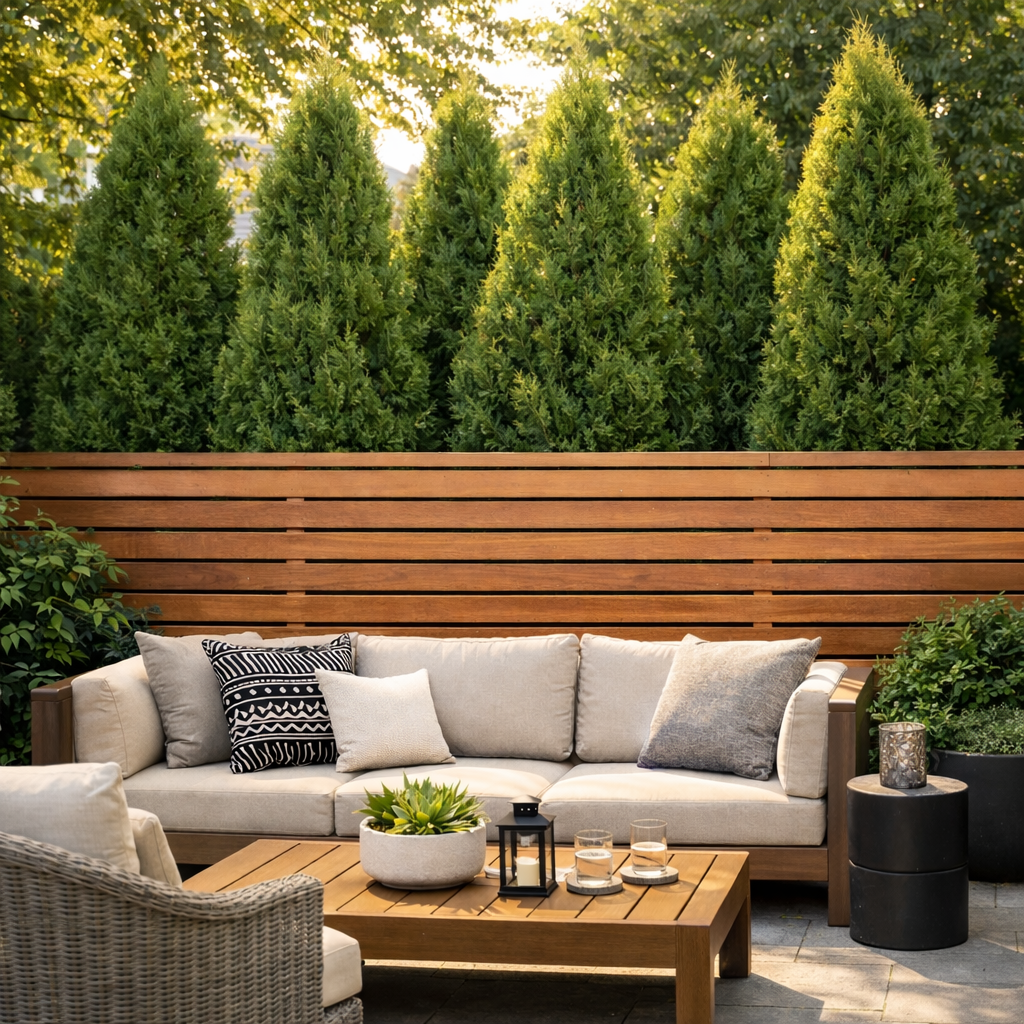
- The Recipe: Install a 6ft horizontal slat fence (modern and airy). Plant ‘Green Giant’ Arborvitae 3 feet inside the fence line.
- Why it works: The fence gives immediate privacy (Day 1). The Arborvitae grows 3-4 feet per year and will surpass the fence in Year 2, eventually reaching 15+ feet to block views completely.
- Alternative for Small Yards: Use Clumping Bamboo (Fargesia species only). It grows tall and narrow but won’t run wild like invasive bamboo.
Problem 2: “They can see me from their second floor”
The hardest problem to solve. A fence is useless here.
The Solution: The “Lollipop” Canopy
You need trees that have a clear trunk (so they don’t eat up your yard space) but a bushy top.
- The Recipe: Plant Pleached Hornbeam or standard-form Photinia trees.
- Placement: Plant them closer to your seating area, not the fence. This geometry blocks the sharp angle of the second-story view with a smaller tree.
- Temporary Fix: While trees grow, install a Pergola with a retractable shade cloth or outdoor curtains over your seating zone.
Problem 3: “My yard is too small for big trees”
Common in townhomes and zero-lot-line properties.
The Solution: Vertical Gardening & Pots
If you can’t plant in the ground, plant up.
- The Recipe: Install a trellis system on top of your existing fence (check local codes). Plant fast-growing vines like Star Jasmine (evergreen) or Clematis.
- The “Mobile Wall”: Use large, rectangular planter boxes (troughs) planted with Horsetail Reed or Snake Plant. These create a 4-5 foot visual barrier that takes up only 12 inches of floor width.
- More Ideas: Check our guide on 10 Backyard Design AI Ideas for Small Spaces for more space-saving tips.
Problem 4: “I can hear their conversations”
Visual privacy is only half the battle.
The Solution: Soundscaping
You cannot block sound effectively with plants (physics says you need a thick earth berm or masonry wall). But you can mask it.
- The Recipe: Install a water feature with a significant “splash” (like a tiered fountain).
- Why it works: White noise (water) helps the human brain “tune out” intelligible speech. It doesn’t silence the neighbor, but it makes their conversation fade into the background.
- Visual Trick: Ornamental Grasses (like Miscanthus) rustle in the wind, adding a second layer of soothing sound.
Problem 5: “I need privacy TODAY”
You have a party next weekend.
The Solution: The “Pop-Up” Screen
- The Recipe: Buy freestanding laser-cut metal privacy screens or wooden lattice panels. Bolt them to your deck or stake them into the ground around your fire pit.
- Style Tip: String café lights across the top of the screens to make them feel like a permanent “room” rather than a temporary fix.
Comparison: Cost vs. Speed vs. Maintenance
Not all solutions are created equal. Choose based on your budget and patience.
| Solution | Est. Cost | Speed to Privacy | Maintenance | Best For |
|---|---|---|---|---|
| Wood Fence (6ft) | $$$ | Immediate | Med (Staining) | Eye-level privacy |
| Arborvitae Hedge | $$ | 2-3 Years | Low (Watering) | Tall screening |
| Bamboo (Clumping) | $$ | 1-2 Years | Med (Clean up) | Fast, dense screen |
| Pergola + Curtains | $$$$ | Immediate | Low | Overhead views |
| Privacy Screen Panels | $ | Immediate | Very Low | Renters / Patios |
| Large Tree (Inst. Mature) | $$$$$ | Immediate | High (Leaves) | Instant solution |
Budget Note: If you are trying to save money, check out our guide on How to Landscape on a Budget to see where to splurge and where to save.
The “Privacy Plant” Cheat Sheet (2025 Top Picks)
Stop guessing what to plant. Here are the winners for specific needs.
| Plant Name | Best For | Hardiness Zones | Growth Rate |
|---|---|---|---|
| Thuja ‘Green Giant’ | Fast, tall screens | Zones 5-9 | 3-4 ft/year |
| Emerald Green Arborvitae | Narrow spaces (3-4ft wide) | Zones 2-8 | 1-2 ft/year |
| Sky Pencil Holly | Very tight spaces (max 2ft wide) | Zones 5-9 | Slow-Med |
| Clumping Bamboo (Fargesia) | Instant height, modern look | Zones 5-9 | Fast |
| Wax Myrtle | Coastal / Sandy soil | Zones 7-10 | Fast |
| Hicks Yew | Deep shade areas | Zones 4-7 | Slow |
Pro Tip: Not sure what your Zone is? Google “USDA Hardiness Zone Map” before buying. A plant that thrives in Florida (Zone 10) will die in a Chicago winter (Zone 5).
4 Critical Checks Before You Dig (The Boring Legal Stuff)
Don’t build a fence you have to tear down.
- Call 811: Always check for buried utility lines before digging post holes. It’s free and often mandatory.
- Check HOA Rules: Many HOAs strictly regulate fence height, materials, and even tree species.
- Verify Property Lines: Don’t guess. Find the iron survey pins. If you build 6 inches onto a neighbor’s lot, they can legally make you move it.
- Height Limits: Most cities cap backyard fences at 6 feet and front yard fences at 3-4 feet.
Visualize Your Sanctuary Before You Buy
It is incredibly difficult to imagine how a “Layered Defense” will actually look. Will that tree block the window? Will the privacy screen feel too closed in?
Don’t guess with your expensive landscape.
- Take a photo of your backyard (specifically the angle where the privacy leak is).
- Upload to YardRevision.
- Prompt: “Backyard with a modern slat fence, a row of arborvitae trees in front, and a pergola with curtains.”
See exactly how the layers work together to block the view before you dig a single hole.