
DIY vs Professional Landscaping: Cost Comparison & When to Hire
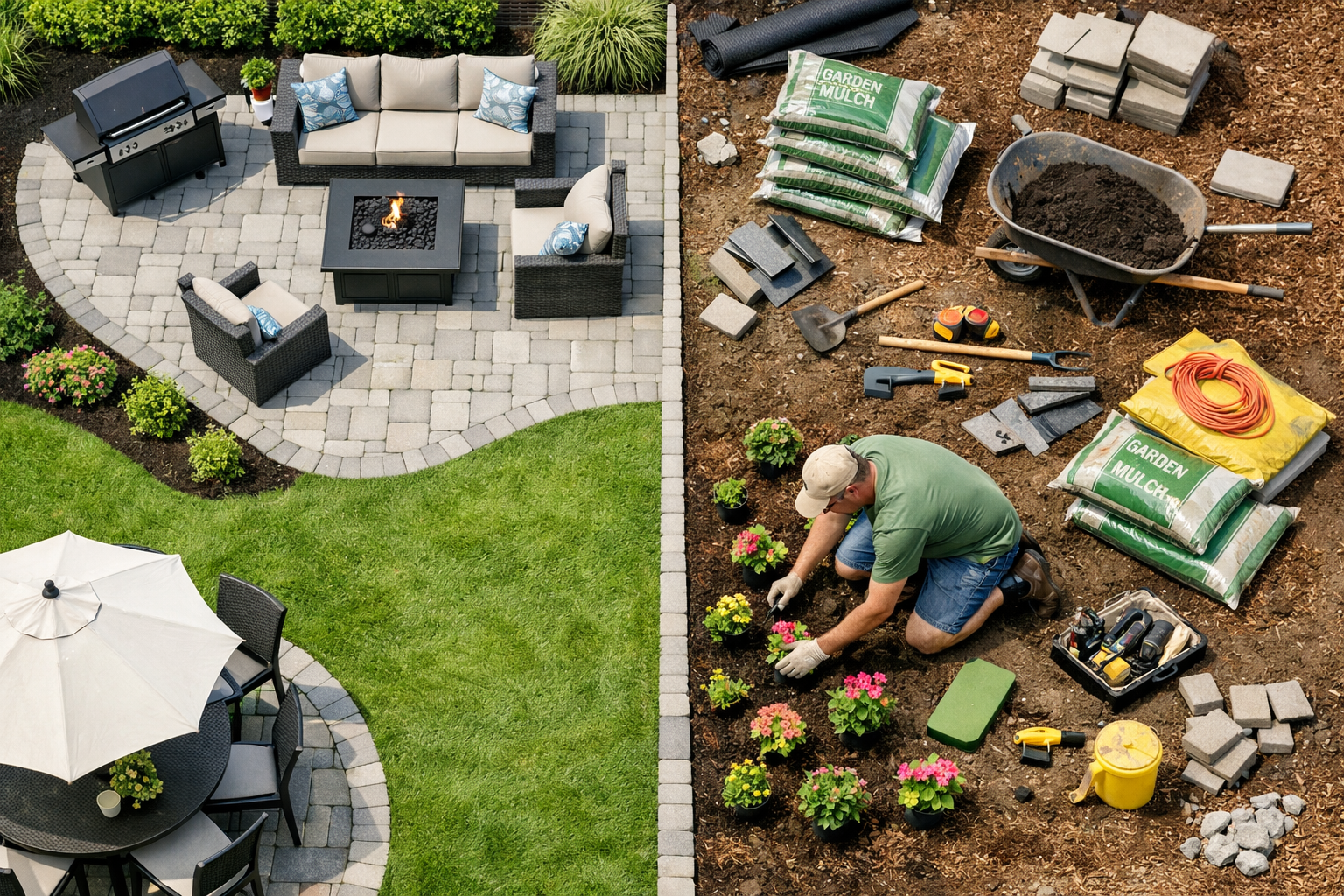
DIY vs Professional Landscaping: Cost Comparison & When to Hire
Here’s a number most landscape contractors won’t tell you: 40–60% of your landscaping bill is labor. That means a $30,000 project might only have $12,000–$18,000 in actual materials.
So should you DIY everything? Absolutely not.
Some landscaping tasks are straightforward weekend projects. Others will cost you more to fix than they would have cost to hire out in the first place. The trick is knowing which is which—before you start digging.
This guide breaks down the real costs task by task, so you can build a hybrid plan that gets professional results on a DIY budget.
The Real Cost Breakdown: DIY vs Professional
Here’s what homeowners actually pay for the most common landscaping tasks. DIY costs include materials and tool rentals. Professional costs include materials, labor, and typical markup.
| Task | DIY Cost | Professional Cost | Typical Savings | DIY Difficulty |
|---|---|---|---|---|
| Mulching (1,000 sq ft) | $150–$300 | $500–$900 | 50–65% | Easy |
| Planting shrubs (10 plants) | $200–$500 | $700–$1,400 | 60–70% | Easy |
| Gravel pathway (30 ft) | $200–$400 | $800–$1,500 | 70–75% | Easy |
| Raised garden beds (3 beds) | $300–$600 | $1,200–$2,000 | 65–75% | Easy |
| Sod installation (1,000 sq ft) | $300–$600 | $1,000–$2,000 | 60–70% | Moderate |
| Drip irrigation system | $200–$500 | $1,200–$2,500 | 75–80% | Moderate |
| Outdoor lighting (8 fixtures) | $300–$600 | $1,500–$3,000 | 75–80% | Moderate |
| Paver patio (200 sq ft) | $800–$1,500 | $3,000–$6,000 | 70–75% | Hard |
| Retaining wall (30 ft, 2 ft tall) | $600–$1,200 | $3,000–$6,000 | 70–80% | Hard |
| Grading and drainage | $200–$500 | $1,500–$5,000 | 75–85% | Hard |
| Tree removal (medium) | Not recommended | $500–$2,000 | — | Dangerous |
Costs are national averages and will vary by region. Get local quotes for accurate pricing.
Key takeaway: The highest savings come from labor-heavy tasks with simple skills—mulching, planting, and gravel. The riskiest DIY tasks involve height, heavy equipment, or underground utilities.
The Best DIY Projects: Where You’ll Save the Most
Start here. These tasks deliver the biggest savings with the lowest risk—and most can be finished in a single weekend.
Mulching and Bed Edging
Savings: 50–65% | Time: 1 weekend
Buy mulch in bulk (not bags—you’ll pay double) and rent a bed edger for about $60/day. This single project transforms the look of your entire yard for a few hundred dollars. Professionals charge $50–$80 per cubic yard installed; you can do it for $25–$40 per yard plus delivery.
Planting Shrubs and Perennials
Savings: 60–70% | Time: 1–2 weekends
The plants cost the same whether you or a landscaper buys them—you’re mostly paying someone to dig holes. Buy from wholesale nurseries when possible. Retail garden centers mark up plants 40–100% over wholesale prices.
Tip: Use YardRevision to visualize plant placement before you buy. Returning 15 shrubs because they looked wrong in person is not a “savings.”
Gravel and Stepping Stone Paths
Savings: 70–75% | Time: 1 weekend
Gravel paths are one of the easiest hardscape projects. The process: dig out 4 inches, lay landscape fabric, spread and compact a gravel base, then top with your decorative stone. Total cost runs $2–$5 per square foot, compared to $10–$20 per square foot installed by a professional.
Drip Irrigation
Savings: 75–80% | Time: 1 weekend
Modern drip irrigation kits are genuinely plug-and-play. Connect the main line to a hose bib, run tubing along your beds, and punch in emitters at each plant. A system that covers several garden beds costs $200–$500 in materials versus $1,200–$2,500 installed professionally.
Landscape Lighting (Low Voltage)
Savings: 75–80% | Time: 1 evening
Low-voltage lighting kits (12V) are safe and simple. Stake the lights, run the wire, plug in the transformer. No electrician, no permit. This is one of the highest-impact, lowest-effort upgrades you can make—your yard looks twice as good at night for a few hundred dollars.
The “DIY Danger Zones”: 5 Jobs You Should Almost Always Hire Out
Saving money is great—until a mistake costs you double. These five tasks carry high consequences for errors, and the “savings” rarely survive the learning curve.
1. Tree Removal Near Structures
A falling tree doesn’t follow your plan. If a tree is within striking distance of your house, fence, or power lines, hire an insured arborist. A $1,500 professional removal is cheap compared to a $15,000 roof repair—or worse, a trip to the emergency room.
2. Retaining Walls Over 3 Feet Tall
Short decorative garden walls? DIY-friendly. But anything taller than 3 feet is a structural element—especially if it’s holding back a slope. These walls need proper footing, drainage behind the wall, and often a building permit. A failed retaining wall can cause property damage, flooding, and liability issues with downhill neighbors.
3. Electrical Work (120V)
Low-voltage landscape lighting (12V) is a great DIY project, as covered above. But running a new 120V circuit for an outdoor kitchen, hot tub, or pool pump requires a licensed electrician and a permit. The risk isn’t just a tripped breaker—it’s a fire or an electrocution hazard in a wet outdoor environment.
4. Major Grading and Earth Moving
Renting a Bobcat sounds fun until you hit a buried gas line. Professional graders call for utility locates (call 811 first regardless), read property surveys, and know how to establish the proper drainage slope away from your foundation. A grading mistake can redirect water toward your house—and foundation repairs start at $5,000.
5. Work That Requires a Permit
If your municipality requires a permit, strongly consider hiring a pro. They know the local codes, handle inspections, and carry liability insurance. Unpermitted work can create legal problems when you sell your home—buyers’ inspectors will flag it, and you may be forced to tear it out and redo it to code.
The Hybrid Approach: Best of Both Worlds
The smartest homeowners don’t choose DIY or professional—they combine both strategically. Hire the pros for the work that’s risky or requires specialized equipment, then handle the finish work yourself.
How the Hybrid Model Works
- Hire a pro for the structural work. Grading, major hardscaping, and tree work are where professional skills prevent expensive mistakes.
- DIY the finishing touches. Planting, mulching, lighting, irrigation, and edging are where you recoup the most savings with the least risk.
- Plan the whole project up front. Whether you use a landscape designer ($500–$2,000 for a full plan) or a visualization tool, having a clear plan keeps both you and your contractors aligned.
Example: A $20,000 Backyard for Under $10,000
Here’s how a hybrid approach cuts a typical backyard renovation nearly in half:
| Category | Task | Approach | Cost |
|---|---|---|---|
| Design | Landscape visualization and planning | DIY with YardRevision | $0 |
| Hardscape | Paver patio (300 sq ft) | Professional | $4,500 |
| Grading | Drainage correction and soil prep | Professional | $2,000 |
| Planting | 20 shrubs + 6 perennial beds | DIY | $900 |
| Mulch | 15 cubic yards, delivered in bulk | DIY | $550 |
| Irrigation | Drip system for all planting beds | DIY | $400 |
| Lighting | 10-fixture low-voltage kit | DIY | $350 |
| Edging | Steel bed edging, 200 linear ft | DIY | $300 |
| Total | Hybrid | $9,000 |
If this same project were fully contracted out, you’d be looking at $18,000–$22,000. The hybrid approach saves roughly $10,000 by doing the labor-intensive but low-skill tasks yourself—without compromising on the parts that need professional expertise.
How to Get the Best Price From a Landscaper
When you do hire a pro, these strategies can save you 15–30%:
- Get quotes in the off-season. Landscapers have less work from November through February. You’ll get better pricing, more attention, and faster scheduling.
- Bundle related tasks. If you need grading and a patio, hiring one crew for both is cheaper than scheduling two separate jobs. The crew is already on-site with the equipment.
- Ask for “rough in” pricing. Have the crew install the patio base and pavers, but skip the final polymeric sand and sealing. You can do that yourself in an afternoon and save a few hundred dollars.
- Get at least three quotes. Prices vary widely between contractors. Three quotes give you a realistic range and leverage for negotiation.
- Bring a visual reference. If you’ve used YardRevision to visualize your design, show the contractor exactly what you want. Clear communication means fewer change orders and less back-and-forth, which saves you both time and money.
Frequently Asked Questions
Q: Is it cheaper to do your own landscaping?
A: For most tasks, yes—DIY saves 50–80% on labor costs. But certain jobs (tree removal, retaining walls, electrical work) can cost more to fix if done incorrectly than they would have cost to hire out. The hybrid approach—hiring pros for structural work and doing the finish work yourself—is usually the most cost-effective strategy.
Q: How much does it cost to landscape a backyard yourself?
A: A full DIY backyard landscape typically costs $3,000–$10,000 in materials, depending on the size of your yard and the materials you choose. Using gravel instead of pavers and buying smaller plants can keep you at the lower end of that range.
Q: What landscaping should I not do myself?
A: Avoid DIY tree removal near structures, retaining walls over 3 feet, 120V electrical work, major grading with heavy equipment, and any work that requires a building permit. These tasks carry safety risks and legal liability that outweigh the labor savings.
Q: Should I hire a landscape designer or just a contractor?
A: A designer creates the plan; a contractor builds it. If your project is simple (adding a patio and some plants), a contractor’s input is usually enough. For a full-yard renovation, a designer’s plan ($500–$2,000) prevents costly layout mistakes and helps you get accurate contractor bids. You can also use an AI visualization tool like YardRevision to explore design ideas before committing to either.
Q: What is the cheapest type of landscaping?
A: Mulching, planting ground cover, and creating gravel paths are the most affordable landscaping improvements. A fresh layer of mulch and some well-placed shrubs can transform a yard for under $500 in materials.
Plan It Before You Build It
Whether you DIY, hire a pro, or go hybrid, the single biggest money-saver is planning before you dig.
The most expensive landscaping mistakes aren’t crooked pavers or wilted plants. They’re design mistakes:
- A patio that’s too small (or too big) for the space.
- A privacy hedge planted where it blocks your best view.
- A drainage plan that sends water toward the house instead of away.
These mistakes cost thousands to fix—but they cost nothing to prevent with a good plan.
YardRevision lets you see your finished landscape before spending a dollar:
- Upload a photo of your current yard.
- Describe your vision: “Stone patio with fire pit, privacy hedge along the back fence, perennial beds on both sides.”
- See the result and adjust until it’s right.
Moving plants in a visualization is free. Moving them in your yard costs a weekend and a sore back.